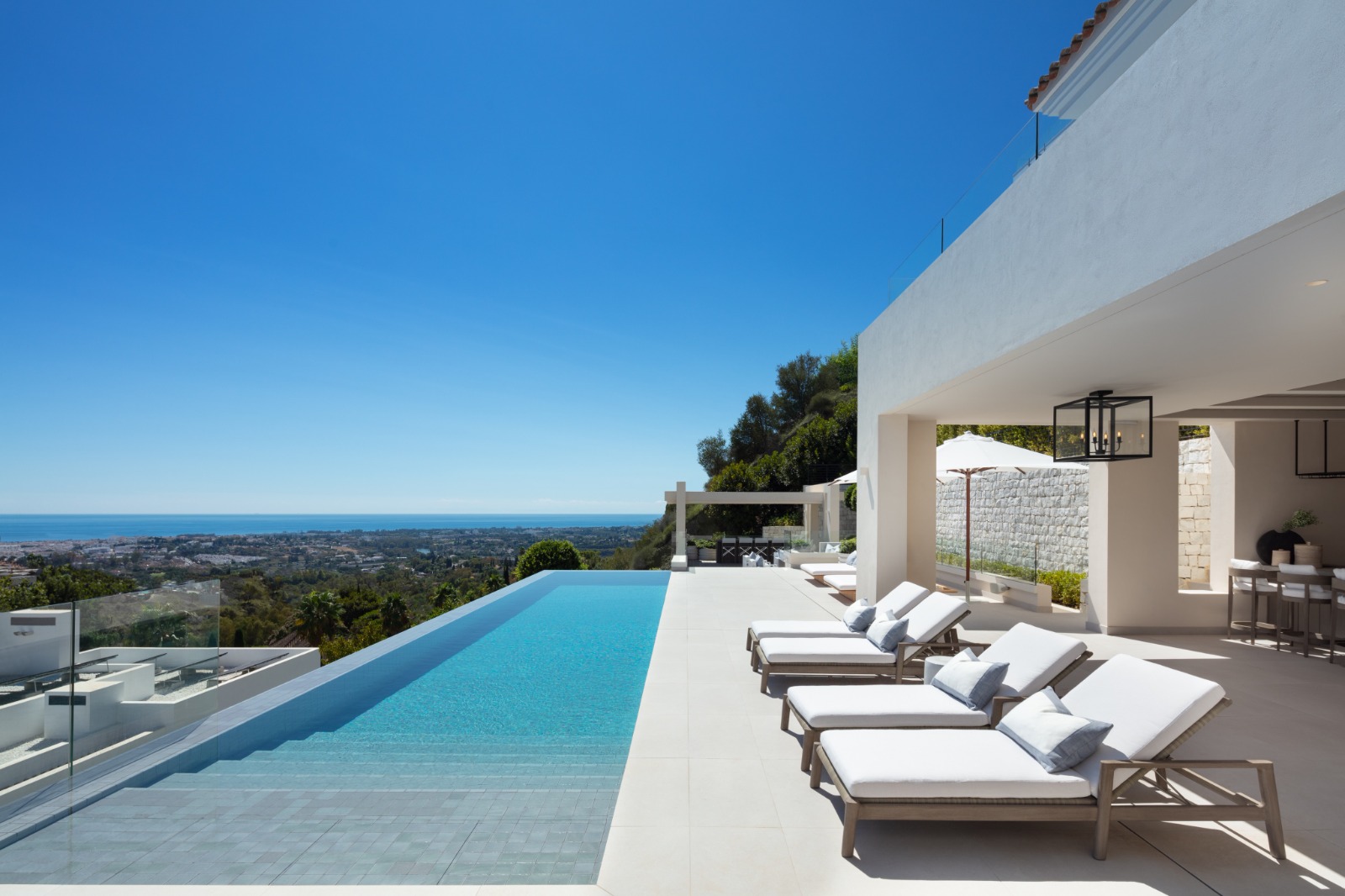

Perched in the hills where Marbella's municipal boundary meets Benahavís, La Quinta occupies a position that is quiet in the way that takes effort to find on the Costa del Sol. It is neither remote nor disconnected: Puerto Banús is ten minutes by car, the Golf Valley of Nueva Andalucía is practically next door, and the beaches of the Golden Mile are within fifteen minutes. What La Quinta offers in exchange for this short daily drive is something that becomes harder to find the closer you get to the coast: space, greenery, mountain air, and the particular calm of a hillside community built around a golf course rather than a coastal road.
The area has been shaped over thirty-five years by a single founding vision, that of Tomás Pascual, who chose this stretch of Benahavís hillside in the late 1980s to develop something different from the apartment-heavy coastal developments that were transforming the Costa del Sol. The result is a neighbourhood of large-plot villas, well-considered apartment complexes, and a five-star Westin golf resort, organised around a 27-hole course designed by Ryder Cup winner Manuel Piñero.
This guide covers La Quinta in full: its neighbourhoods, the golf, the Westin, the schools, the hiking, and what the experience of living here day-to-day actually involves.
What Is La Quinta?
La Quinta is a residential golf community situated in the municipality of Benahavís, in the province of Málaga, Andalusia. It sits in the foothills of the Sierra Blanca at the northern edge of Nueva Andalucía, at the point where the Golf Valley of Marbella gives way to the more open countryside that stretches inland towards the Serranía de Ronda.
The area is not a single gated community but a collection of distinct residential zones, each with its own character, organised around the La Quinta Golf and Country Club and the Westin La Quinta Golf Resort and Spa. These sub-areas include El Herrojo, Los Arcos, Los Balcones, El Mirador, La Quinta Hills, Soto de La Quinta, Lomas de La Quinta, La Quinta Greens, Buena Vista de La Quinta, and Altos de La Quinta.
The founding of La Quinta as a residential project dates to the late 1980s when Tomás Pascual, founder of Corporación Pascual, one of Spain's major food industry businesses, acquired land in this part of Benahavís and began developing what would become both the golf course and the surrounding residential areas. La Quinta Real Estate Group was established formally in 1992 and has since developed more than 1,000 homes across more than 160 hectares. The group is family-owned and continues to be led by the Pascual family, with Borja Pascual, son of the founder, serving as Chief Executive.
Where Is La Quinta?
La Quinta is located in the municipality of Benahavís, north of Nueva Andalucía and the Golf Valley of Marbella. It is accessed via exit 172 from the AP-7 motorway towards San Pedro de Alcántara and Ronda, from which a secondary road leads directly to the La Quinta Golf Club and the surrounding residential areas. The urbanisation borders Nueva Andalucía to the south and east, open countryside and the Sierra de las Nieves natural park to the north, and the Río Guadaiza valley to the west.
~10 mins
to Puerto Banús
~15 mins
to the Golden Mile
~45 mins
to Málaga Airport
~12 mins
to Benahavis Village
Despite its position above the coastal strip, La Quinta is well connected. The AP-7 toll motorway provides fast access to Marbella and Málaga in one direction and to Estepona and Gibraltar in the other. The drive to Puerto Banús takes approximately ten minutes, making it realistic as a daily commute or regular social destination.
The Neighbourhoods of La Quinta
Understanding La Quinta requires understanding that it is a collection of distinct residential areas rather than a single uniform development. Each has its own character, price point, and type of property.
El Herrojo
El Herrojo is consistently regarded as La Quinta's most prestigious sub-area. A gated community of private villas on generous plots, it is one of the few exclusively villa communities in the wider Marbella area with full security at its entrance points and dedicated patrol coverage. Properties in El Herrojo are typically larger and positioned on elevated ground, with exceptional panoramic views across the Golf Valley, towards La Concha mountain, and out to the Mediterranean and Gibraltar beyond. The combination of gate security, plot sizes, and views makes it one of the more sought-after addresses in the La Quinta area.
Los Arcos and Los Balcones
Los Arcos and Los Balcones are established residential zones with a mix of villas and townhouses, popular with families and year-round residents for their well-maintained communal areas and convenient access to the golf club.
La Quinta Hills, Lomas de La Quinta, and Altos de La Quinta
La Quinta Hills, Lomas de La Quinta, and Altos de La Quinta are elevated sections of the urbanisation offering the most commanding views within the existing development. Properties here face south and southwest, with wide-angle perspectives across the Golf Valley to the coast.
La Quinta Greens and Buena Vista de La Quinta
La Quinta Greens and Buena Vista de La Quinta are apartment-led developments, well-regarded for their quality construction, community management, and accessibility to the golf course and resort facilities.
Soto de La Quinta
Soto de La Quinta provides a quieter, more tucked-away residential environment within easy walking distance of the golf club facilities.
The Views and Microclimate of La Quinta
La Quinta's elevated position in the Benahavís foothills produces two qualities that are genuinely difficult to replicate in the coastal addresses below, and that residents consistently identify as among the defining characteristics of daily life here: the views and the climate.
The Views
The panoramic southward perspective from La Quinta's upper residential areas and golf fairways is one of the most expansive available from any permanently inhabited address in the Marbella area. The elevation, sitting at between 200 and 350 metres above sea level depending on the specific sub-area and plot, provides sufficient height to look clear over the immediate coastal strip and out across the full width of the Bay of Marbella. The view encompasses the Golf Valley of Nueva Andalucía in the foreground, a sweeping arc of the Mediterranean coastline from Estepona in the west to Málaga in the east, the outline of Gibraltar's rock on the western horizon, and on the clearest days in winter and early spring, the profiles of the Rif Mountains of Morocco on the southern horizon across the Strait.
What distinguishes La Quinta's views from those available from Sierra Blanca or Cascada de Camoján, which are broadly comparable in elevation, is the depth of the foreground. Rather than looking directly down to the coastal road and the beach, residents at La Quinta look first across the Golf Valley, with its rolling fairways, pine woodland, and the rooftops of Nueva Andalucía. This intermediate landscape gives the view a quality of distance and layering that is genuinely unusual. The sea, when it appears at the far edge of this foreground, feels properly far away, which makes it more, not less, impressive.
Within the urbanisation, view quality varies meaningfully by sub-area. The highest positions, in El Herrojo, La Quinta Hills, Lomas de La Quinta, and Altos de La Quinta, offer the widest sightlines and the most complete coastal panoramas. La Concha mountain, Marbella's defining peak at 1,215 metres, dominates the eastern skyline from most elevated positions within La Quinta, close enough to be a constant and commanding presence rather than a distant feature of the landscape.
The Microclimate
La Quinta's position in the foothills of the Sierra Blanca and Sierra de las Nieves creates a microclimate that differs meaningfully from the coastal strip below, in ways that are consistently positive for outdoor living.
In summer, the elevation keeps temperatures several degrees lower than the beach areas. The difference between a July afternoon in Puerto Banús and the same afternoon at La Quinta can be between three and five degrees Celsius. For residents who value outdoor exercise, the ability to run, cycle, or play golf in the summer months without the oppressive heat of the coastal strip is a practical quality-of-life advantage that is difficult to quantify but is mentioned consistently by those who have lived in both types of location. Morning temperatures are reliably pleasant from early spring to late autumn, which means outdoor activity before breakfast is a viable daily habit rather than an occasional pleasure.
The Sierra Blanca to the north and northeast acts as a partial barrier to cold winter winds, keeping La Quinta noticeably more sheltered than more exposed hillside positions on the coast. The combination of this shelter and the south-facing orientation of most of La Quinta's residential areas means that winter afternoons are warm enough to sit on an outdoor terrace for most of the year. Marbella as a whole averages more than 300 days of sunshine annually, and La Quinta's microclimate captures this advantage without the humidity that can characterise the seafront in high summer.
The overall effect is a version of the Costa del Sol's celebrated climate that is slightly refined: a little cooler when heat is the issue, a little calmer when wind is the problem, and with the additional quality of mountain air that comes with the altitude. For buyers who intend to use their property for genuine extended residence rather than occasional visits, this microclimate is a meaningful practical consideration that photographs of a view or descriptions of a golf course cannot fully convey.
The Golf
Golf is not simply an amenity at La Quinta: it is the organising principle around which the entire community was built, and it remains central to why people choose to live here.
La Quinta Golf and Country Club
La Quinta Golf and Country Club was designed by Manuel Piñero, the Spanish golfer who was a three-time World Champion and a key member of Seve Ballesteros's successful Ryder Cup teams of the 1980s. The course opened in 1989 as a 27-hole layout divided into three separate nine-hole courses: San Pedro, Ronda, and Guadaiza. This three-loop structure is one of the course's most practical features: it allows different 18-hole combinations to be played depending on conditions, group composition, and personal preference, giving the course a variety that most 18-hole layouts cannot offer. The course is typically played as a par-72 championship layout, with generous fairways, rolling terrain that works with rather than against the natural hillside, and well-protected greens.
The views throughout the round are exceptional. From the elevated fairways, sightlines extend across the Golf Valley to the Mediterranean, with Gibraltar visible in clear conditions and La Concha mountain dominating the skyline to the northeast. Severiano Ballesteros, José María Olazábal, and Manuel Piñero himself have all competed on the course since its opening, a level of playing history that reflects both the quality of the design and its reputation within the Spanish golfing community.
The Clubhouse has a gourmet restaurant with a panoramic terrace facing the golf course and the sea beyond, a golf shop, and full practice facilities including a driving range. The absence of public tee time pressure, and the relatively uncrowded conditions that La Quinta enjoys compared to the more publicly accessible courses of the Golf Valley, is frequently cited by residents as one of the practical pleasures of playing here.
Golf Beyond La Quinta
For residents who play regularly, the Golf Valley of Nueva Andalucía, practically adjacent to La Quinta's southern boundary, provides immediate access to Aloha Golf Club, Real Club de Golf Las Brisas, and Los Naranjos Golf Club, three of the most established championship courses on the Costa del Sol. Real Club Valderrama is approximately 40 minutes west. The concentration of courses available within a 20-minute radius of La Quinta is one of the finest of any residential area in Spain.
The Westin La Quinta Golf Resort and Spa
The five-star Westin La Quinta Golf Resort and Spa is the social and amenity centre of the existing La Quinta urbanisation, providing hotel-standard facilities that are also accessible to residents in the surrounding community.
The resort comprises 170 rooms and suites designed in an elegant contemporary style with strong Andalusian architectural references: whitewashed walls, Moorish decorative elements, and natural materials throughout. Rooms overlook the golf course, gardens, or the surrounding hills, and all include private terraces. The Presidential Suite and Executive Suites represent the most spacious options within the property.
Sunsa Restaurant is the hotel's signature dining venue, focused on healthy and locally sourced cuisine paired with international influences, with a menu designed around regional Andalusian ingredients and nutritional balance. The Clubhouse Restaurant and Bar occupies the golf course clubhouse and operates throughout the year with a terrace that captures panoramic views across the Golf Valley and towards the coast.
The Heavenly Spa by Westin covers over 1,500 square metres in a Moorish-inspired design, with a comprehensive thermal circuit including saunas, aromatic steam baths, and relaxation areas, alongside a full range of treatment rooms and fitness facilities. The outdoor pool complex is set within subtropical landscaped gardens.
The resort's kids club, operating in July and August for children aged four to twelve, is a well-organised facility across a 1,000-square-metre space with indoor and outdoor activities. For La Quinta families, the combination of the kids club, the golf course, and the resort's open gardens provides a practical leisure resource during the school holiday period.
Things to Do In and Around La Quinta
Hiking
La Quinta sits at the base of the Sierra de las Nieves, one of the most biologically significant mountain ranges in southern Spain and designated both a National Park and a UNESCO Biosphere Reserve. The trail network accessible from the La Quinta area extends directly into the reserve, without the need for a lengthy drive to reach the trailheads.
The most celebrated hiking destination from La Quinta is the Holy Chestnut, or El Castaño Santo, a remarkable tree that is considered the oldest in the entire Sierra de las Nieves, estimated to be between 800 and 1,000 years old. Its trunk has a perimeter of approximately 13.5 metres, an extraordinary scale that has to be experienced in person to be properly appreciated. The walk from the La Quinta Golf Club through the Guadaiza valley to the Holy Chestnut and back covers approximately 13 kilometres and passes through a dramatic landscape of cork oak, wild olive, and pine forest, with the Rio Guadaiza accompanying much of the route. The round trip takes around four hours at a comfortable pace.
For shorter and more immediate walking from within the urbanisation itself, the surrounding countryside offers well-worn paths through Mediterranean scrubland and oak woodland. The proximity of the Sierra de las Nieves means that more ambitious multi-day routes are also accessible, and the park's trail network includes routes connecting to Ronda, the Serranía de Ronda, and the upper reaches of the Guadaiza and Guadalmina river valleys.
Cycling is popular on the roads within and around the urbanisation, particularly on the quieter roads above the main residential areas, where traffic is minimal and gradients provide a meaningful workout.
Horse Riding
The countryside surrounding La Quinta is among the most scenic in the Marbella area for horse riding, with trails through open terrain, wooded valleys, and hillside paths that offer views across the Golf Valley to the coast. Several equestrian centres and riding schools operate in the surrounding Benahavís area, offering trail rides, lessons, and livery services. For residents who ride regularly, the access to genuinely open countryside from La Quinta is a significant advantage over the more constrained coastal locations.
Marbella Football Centre
La Quinta is home to the Marbella Football Centre, one of the most technically sophisticated football training complexes in Europe. The facility hosts pre-season training camps and preparation visits from professional football clubs at the highest level, with its combination of pitches, sports science facilities, and the Costa del Sol climate making it an attractive winter destination for European clubs. For residents with children who play football seriously, the proximity of a facility of this standard is an unusual and practical local advantage.
Benahavís Village
Benahavís, eight kilometres from La Quinta along a scenic mountain road that winds through a wooded gorge, is one of the most consistently well-regarded dining destinations on the Costa del Sol. The village's reputation for restaurants, concentrated primarily on its main street, has been built over decades on the quality of its traditional Andalusian cooking: grilled meat, fresh fish, local game, and dishes prepared with the produce of the surrounding countryside. Long lunches in Benahavís after a morning golf round have become a well-established rhythm for many La Quinta residents. The village itself is well-preserved architecturally and retains a genuine Andalusian character that the coastal towns directly below have largely ceded to tourism and development.
Water Sports and the Beach
The beaches of Puerto Banús and the Golden Mile are ten to fifteen minutes by car from La Quinta. Puerto Banús provides the full range of water sports and boat charter options available on the Costa del Sol, from jet skiing and paddleboarding to private yacht hire and dolphin-spotting excursions. The proximity of Puerto Banús also gives La Quinta residents access to its marina-side dining, luxury boutiques, and beach clubs within a practical daily journey.
Dining In and Around La Quinta
La Quinta's immediate dining offer is concentrated around the Westin resort facilities and a small number of standalone restaurants within and immediately adjacent to the urbanisation.
Sunsa at the Westin provides the most convenient fine dining option within the area, with a menu rooted in healthy and locally sourced cuisine in a contemporary setting with golf course views. The Clubhouse Restaurant at the golf club serves throughout the day with a terrace that is one of the most pleasant outdoor dining settings in the immediate area, facing across the fairways with the sea on the horizon.
El Gamonal, a family-run restaurant two minutes from the golf club, has built a loyal following among La Quinta residents for its traditional Andalusian-Mediterranean cooking: roast meats, grilled fish, and dishes made from local produce in an unhurried, welcoming environment that feels genuinely Spanish in a way the resort restaurants cannot always replicate.
Beyond the immediate area, the options expand significantly. Benahavís village, twelve minutes by car, is one of the Costa del Sol's most consistent restaurant destinations, with a range of traditional Andalusian establishments that draw diners from across the region. Nueva Andalucía and its surrounding areas, practically on La Quinta's doorstep, provide a broad selection of international and Mediterranean cuisine at every price point. Puerto Banús, ten minutes away, extends this to marina-side dining, beach club restaurants, and the full hospitality offer of one of the Mediterranean's most active marina destinations.
Schools Near La Quinta
La Quinta is well served by international schools, with several strong options within a short drive in different directions.
Aloha College
Aloha College in Nueva Andalucía, approximately five kilometres south of La Quinta, is one of the most established British curriculum schools on the Costa del Sol, educating students from age four to eighteen in an environment with strong academic results and a well-developed extracurricular programme.
Laude San Pedro International College
Laude San Pedro International College in San Pedro de Alcántara, approximately ten minutes by car, offers both the British National Curriculum and the Spanish curriculum across its primary and secondary programmes, making it a strong option for families who want bilingual or dual-curriculum education.
St George's School and Calpe School
St George's School and Calpe School in San Pedro de Alcántara cater to younger age groups, with St George's covering ages three to eight and Calpe School from ages two to eleven, providing options for primary-age children within a very manageable distance.
The American and Swedish School
The American College in Spain and the Svenska Skolan (the Swedish School) in Nueva Andalucía address the needs of American and Scandinavian families respectively, both within fifteen minutes of La Quinta.
Colegio San José
For families whose preference is towards a Spanish curriculum, Colegio San José in San Pedro de Alcántara covers the full age range from primary through to secondary with a well-regarded bilingual programme.
The concentration of international schools within ten to fifteen minutes of La Quinta, covering British, Spanish, American, and Scandinavian educational frameworks, is one of the most practical advantages the area offers for international families with children of school age.
Safety in La Quinta
Security varies across the different sub-areas of La Quinta, which is a useful detail for buyers. El Herrojo operates as a fully gated community with 24-hour security at its entrances and regular patrol coverage throughout. Several other residential complexes within La Quinta operate their own community security.
The overall character of the area, its position at the end of a series of residential roads rather than on any through-route, its low traffic volumes, and its predominantly permanent-resident community, contributes to a baseline of calm and security that residents consistently describe as one of the most appreciated aspects of daily life here.
The proximity of San Pedro de Alcántara's police station and Marbella's urban security infrastructure means that emergency response distances are practical rather than remote.
What Daily Life in La Quinta Is Actually Like
La Quinta appeals to a specific kind of resident: someone who values outdoor life, quality space, and genuine quiet over the proximity to beach clubs and nightlife that drives purchasing decisions in other parts of the Marbella area. The buyers who choose La Quinta tend to be families with children, golfers who want the course on their doorstep, and professionals who work remotely and want a high-quality environment for day-to-day living without the noise and congestion of the coastal corridor.
The mornings at La Quinta begin with the sounds of birdsong and the views of La Concha mountain above and the Golf Valley below. A morning round of golf is possible without leaving the neighbourhood. The trails that lead north into the Sierra de las Nieves begin within a short drive, and the Holy Chestnut trail gives even a casual walker a remarkable natural destination for a morning's exercise. The children's school run takes ten to fifteen minutes in most directions. Lunch is in Benahavís or in Nueva Andalucía. The afternoon is the golf course, the Westin spa, or the trails. The evening is the resort restaurant, a drive to Puerto Banús, or a terrace at home with the lights of the coast stretching in both directions.
What La Quinta does not offer, and what buyers should understand clearly, is the kind of immediate beach access, proximity to marina nightlife, and social energy that the coastal addresses provide. The beach is fifteen minutes away. The restaurants of Puerto Banús are ten minutes. These are real distances, not theoretical ones, and residents who make this choice make it consciously, in exchange for the kind of setting, space, and quiet that the hillside position above the Golf Valley uniquely provides on the western Costa del Sol.
La Quinta sits within the municipality of Benahavís, not Marbella, though it borders Marbella's municipal territory and is often referred to in the context of the wider Marbella area. For property buyers, this distinction matters in terms of local taxes, planning permissions, and municipal services, all of which fall under Benahavís rather than Marbella Town Hall.
Very much so. It is one of the strongest family destinations in the wider Marbella area. Several international schools are within ten to fifteen minutes. The Westin kids club operates in summer. The golf course and trails provide outdoor activities for all ages. The residential character of the area, particularly in gated communities like El Herrojo, creates a calm and secure environment for children. The Holy Chestnut trail and Sierra de las Nieves provide exceptional natural outdoor space on the doorstep.
The beaches of Puerto Banús and the Golden Mile are approximately ten to fifteen minutes by car. This is a genuine daily drive rather than a walk, and buyers should factor it into their assessment. La Quinta is a hillside golf community, not a coastal address. The proximity is practical rather than immediate.
La Quinta Golf and Country Club (27 holes, on-site) is the immediate option, and within ten minutes: Aloha Golf Club, Real Club de Golf Las Brisas, and Los Naranjos Golf Club in the Golf Valley of Nueva Andalucía. Real Club Valderrama is approximately 40 minutes west. The concentration of championship courses accessible from La Quinta is one of the finest available from any single residential address in southern Spain.
The Holy Chestnut (El Castaño Santo) is thought to be the oldest tree in the Sierra de las Nieves, estimated at between 800 and 1,000 years of age, with a trunk perimeter of approximately 13.5 metres. It is reached via a 13-kilometre round-trip trail beginning from La Quinta Golf Club, following the Guadaiza valley northward through oak and pine forest. The walk takes approximately four hours at a comfortable pace.
El Herrojo is La Quinta's most prestigious sub-area and one of the few exclusively villa communities in the wider Marbella area with full gated security and dedicated patrol coverage. Most other La Quinta sub-areas include a mix of villas, townhouses, and apartments, with communal rather than fully gated perimeter security. El Herrojo commands a premium within La Quinta's property market that reflects its security provision, plot sizes, and elevated position with exceptional views.