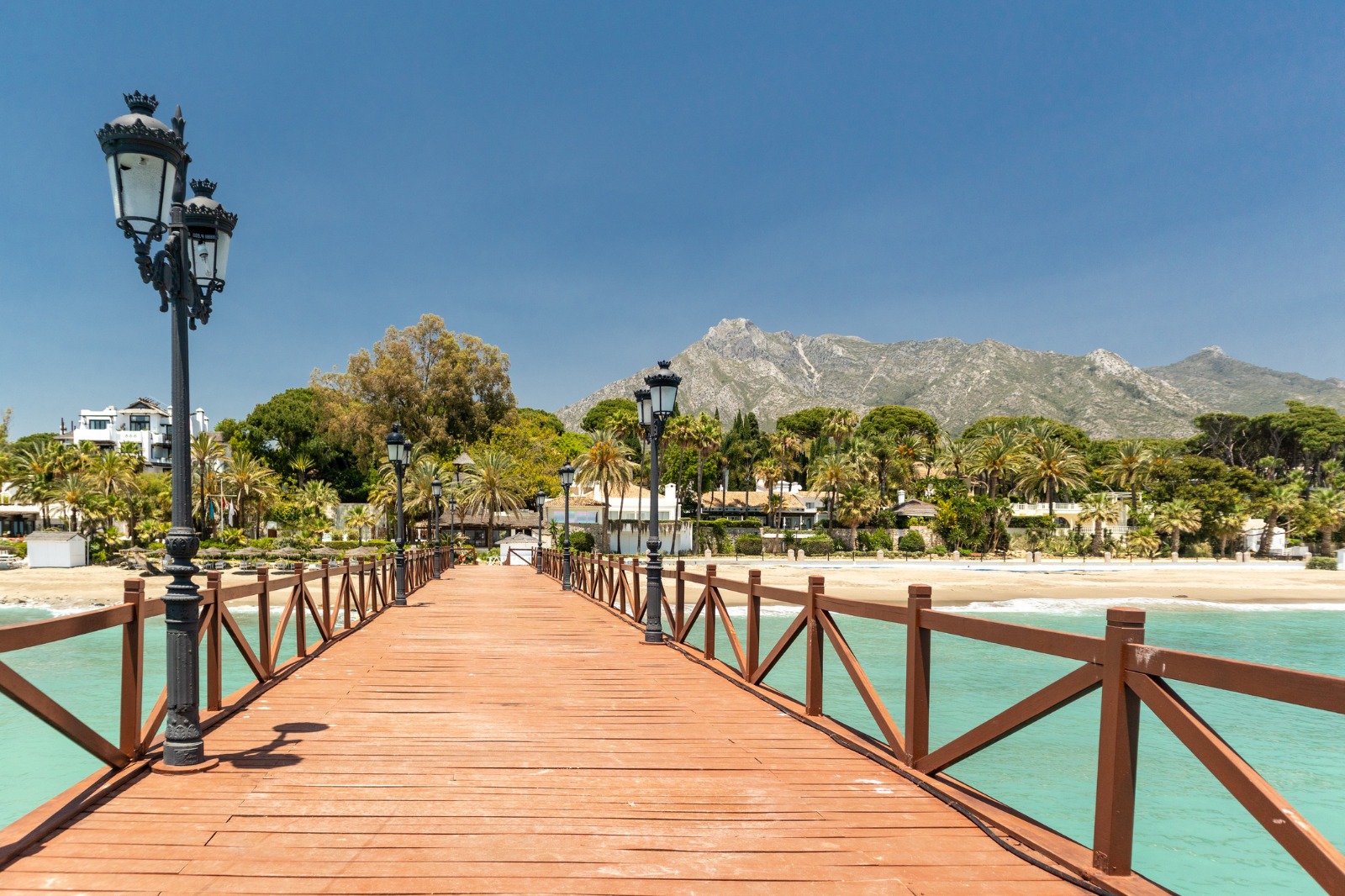

There is a stretch of the Costa del Sol that has been drawing the world's most discerning travellers, residents, and adventurers since the 1950s. Five kilometres of coastline running between Puerto Banús and Marbella's town centre, flanked by the Sierra Blanca to the north and the Mediterranean to the south, is the Marbella Golden Mile. It is not simply a prestigious address. It is a complete lifestyle, one that combines five-star luxury with a surprisingly active, outdoors-focused way of living that many residents consider the real reason they chose to be here.
This guide is written for anyone wanting an honest and thorough understanding of the Golden Mile: its history, its neighbourhoods, what you can do here, what lies just beyond it in the surrounding countryside and coastline, and what day-to-day life in this corner of Andalusia genuinely looks like.
What Is the Marbella Golden Mile?
The Marbella Golden Mile is a prestigious coastal zone running parallel to the Mediterranean for approximately five kilometres, from the Inspiraya Clinic in the west to the distinctive Pirulí lighthouse structure at the eastern entrance to Marbella town. The N-340/A-7 coastal road forms its spine, but the Golden Mile extends both down to the beach and up into the lower foothills of the Sierra Blanca, with the residential neighbourhood of Nagüeles marking its upper limit.
It is not an officially designated administrative district. There are no formal boundary signs and no civic paperwork that defines where it begins and ends. Yet residents, professionals, taxi drivers, and visitors alike universally understood the term across Marbella: to describe one of the most sought-after residential corridors in southern Europe.
Where Is the Marbella Golden Mile Located?
The Golden Mile sits at the geographic heart of the Costa del Sol's luxury corridor, directly between Puerto Banús to the west and Marbella's historic Old Town to the east. It connects to both the A-7 coastal road and the AP-7 toll motorway, giving residents fast access to the entire coastline and the inland mountain villages.
~8 min
to Puerto Banús
~8 min
to Marbella Old Town
~37 min
to Málaga International Airport
~27 min
to Estepona
For those who travel frequently for business or spend time between properties, the proximity to Málaga Airport is a significant practical advantage, under 40 minutes on the AP-7.
A Brief History of the Marbella Golden Mile
The Marbella Golden Mile as it exists today was shaped not by centuries of gradual development but by a handful of decisive moments in the mid-twentieth century.
Prince Alfonso and the Marbella Club (1954)
The story begins in 1954 when Prince Alfonso de Hohenlohe, an Austrian-Spanish aristocrat with a gift for hospitality and an eye for beauty, began developing a private residence on what was then an undeveloped coastal road lined with orange groves and pine trees. His intention was to create an intimate retreat for his circle of European aristocrats and international friends. That property evolved into the Marbella Club Hotel, a name that would define luxury tourism on the Costa del Sol for generations.
Word spread quickly through Europe's most exclusive social networks. By the late 1950s, the area had become the preferred Mediterranean summer escape for some of the most prominent names of the era. Audrey Hepburn was among the most celebrated visitors, and the Golden Mile earned a reputation as the place where Hollywood and European aristocracy met under the Andalusian sun.
Royal Presence and Global Recognition
The 1970s brought a different kind of prestige. The Al Riyadh Palace and Mosque were constructed along the strip, and Saudi King Fahd established his summer residence here: a presence that brought significant investment to the area and extended its reputation well beyond Europe. By this point, the Golden Mile had transitioned from a fashionable hideaway into a genuinely global destination.
The Origin of the Name
The name itself has a specific and often misunderstood origin. Originally, it referred to the distance of approximately one mile between the Marbella Club Hotel and the Puente Romano Resort, the two landmark properties that anchored the area's early development. As the surrounding neighbourhood expanded over the following decades, the name remained, even as the area grew to five kilometres. Today it functions as much as a concept as a measurement: shorthand for the standard of living this stretch of coastline represents.
A Sporting First
One footnote in the Golden Mile's history deserves particular mention. In 1974, the first padel courts ever built in Spain were constructed within the grounds of the Marbella Club Hotel. The sport, which has since become one of the most widely played in Spain with millions of active participants, was effectively introduced to the country right here on the Golden Mile.
The Beaches of the Marbella Golden Mile
The beaches fronting the Golden Mile hold Blue Flag certification, the internationally recognised standard awarded for water quality, environmental management, and visitor safety. This is not a formality; the beaches here are genuinely well maintained, regularly monitored, and among the cleanest on the Costa del Sol.
The shoreline runs the length of the area and is accessible via a promenade that connects Marbella town centre with Puerto Banús, a continuous coastal walkway that is one of the longest and most pleasant in the region. The beach experience varies along the strip. The sections closest to the landmark hotels tend to feature beach clubs with full service, sun lounger rental, and restaurants. Stretches between them are more open and relaxed, popular with local families and morning swimmers.
The calm of the western Mediterranean means the water is gentle and safe for swimming for most of the year, and the orientation of the coast gives the beaches good sun throughout the day.
Things to Do on the Marbella Golden Mile
One of the most consistent surprises for people who associate the Golden Mile purely with luxury and exclusivity is how genuinely active and outdoors-focused life here is. The combination of the Mediterranean to the south and the Sierra Blanca to the north creates a natural environment for an unusually diverse range of activities, many of which are available within minutes of the Golden Mile itself.
On the Promenade
The Paseo Marítimo, the coastal promenade connecting the Golden Mile to both Marbella town and Puerto Banús, is one of the most used public spaces in the area. Wide, well-paved, and separated from traffic, it is popular for running, cycling, walking, and roller skating at any time of day. In the early mornings it fills with residents doing their daily exercise; in the evenings it becomes more social. The climate means it is genuinely usable throughout the year, not just in summer.
Tennis
The Puente Romano Tennis Club is one of the most prestigious tennis facilities in Europe and sits directly on the Golden Mile. It has hosted professional tournaments for decades, including top-level international competitions, and offers courts, professional coaching, and facilities to a standard that few places anywhere in the world can match. For residents who take tennis seriously, having this on the doorstep is a significant draw. The club has clay courts, plexipave courts, and a full programme of coaching for all ages and abilities.
Padel
Given that padel was born here, it is fitting that the Golden Mile and its surroundings offer excellent padel infrastructure. The Real Club Pádel Marbella is one of the most comprehensive sports clubs in the area, with six padel courts alongside a full gym, HYROX training, spa facilities, and a martial arts programme across over 10,000 m² of space. For those wanting something closer to the Golden Mile's beach side, padel courts exist within several of the residential urbanisations and the Puente Romano complex.
Golf
The Golf Valley of Nueva Andalucía sits approximately ten minutes west of the Golden Mile and is home to several championship courses, including Aloha Golf Club, Las Brisas, and Los Naranjos. Aloha has hosted the Andalusian Open on multiple occasions and is one of the finest parkland courses in southern Spain. Rio Real Golf, to the east of Marbella, is another well-regarded option. For Golden Mile residents who play regularly, access to this level of golf within such a short distance is one of the area's defining lifestyle advantages.
Wellness and Spa
The Six Senses Spa at the Puente Romano Resort is the only Six Senses property on mainland Spain and is widely regarded as the most complete wellness destination on the Costa del Sol. The facilities include a hydrotherapy pool, cold plunge, sauna, steam room, hammam, and six individual treatment rooms. The spa's programming goes beyond treatments to encompass fitness classes, nutritional guidance, and longer wellness retreats.
The Puente Romano Health and Fitness centre is attached to the same complex and offers a well-equipped gym alongside group classes, personal training, spinning, boxing, barre, and an outdoor jungle gym area.
Water Sports
The Golden Mile's beachfront is one of the most active stretches for water sports on the Costa del Sol, with calm Mediterranean conditions and a well-established network of operators making it easy to get on the water year-round. Jet ski hire is available directly from the beach and from Puerto Banús, eight minutes away, alongside more unusual options such as flyboarding and electric hydrofoil boards.
Stand-up paddleboarding and kayaking are popular for their accessibility and the spectacular views back towards La Concha, while parasailing offers a different perspective on the coastline entirely. Puerto Banús functions as the area's main boat charter hub, with options ranging from private sailing catamarans and motor yachts to dolphin-spotting trips, sunset cruises, and deep-sea fishing charters. Windsurfing is best in spring and autumn when the Poniente and Levante winds come into their own, and for those who want to explore beneath the surface, several operators offer PADI diving courses and guided snorkelling excursions from the marina.
Dining on the Marbella Golden Mile
The concentration of high-quality restaurants on the Golden Mile is one of the most impressive in the south of Spain. The range spans fine dining at international level to relaxed beachside eating, with very little in between that could be described as mediocre.
Fine Dining
Leña, the contemporary wood-fire grill restaurant from celebrated Andalusian chef Dani García, within the Puente Romano Resort, has become one of the most talked-about dining destinations on the Costa del Sol since opening. The focus is on premium cuts, fire, and bold Andalusian flavour, and the room itself has received considerable international attention for its design.
El Patio, set within the gardens of the Marbella Club Hotel, represents the older, more classic end of the Golden Mile's dining scene, long lunches in a historic setting with excellent service and a menu that reflects the Mediterranean surroundings.
Cipriani Marbella brings the traditions of the legendary Harry's Bar in Venice to the Golden Mile, including the original Carpaccio alla Cipriani that was invented there. For those who value culinary heritage, it is one of the most distinctive dining experiences in the area.
COYA offers a different register entirely: Peruvian-influenced cuisine with a strong emphasis on ceviche, fish tiraditos, and wagyu, served in an atmosphere that combines good food with genuine energy. It is one of the better options for groups or for evenings when the atmosphere matters as much as the plate.
Casual and Beachside Dining
The chiringuitos that line the Golden Mile's beachfront represent one of the most genuinely Andalusian dining experiences available in this corner of Marbella. Fresh grilled fish, espetos (sardines on a skewer cooked over an open fire), cold drinks, and a table on the sand. This is a tradition that runs counter to the Golden Mile's luxury image but is, for many residents, what they value most about living here.
Beyond the Golden Mile
Marbella Old Town, five minutes by car, has one of the most pleasant dining environments in Andalusia. The Plaza de los Naranjos, a well-preserved historic square surrounded by orange trees, is lined with restaurants and tapas bars and is at its best on warm evenings. Puerto Banús, eight minutes away, offers marina-side dining across a wide range of cuisines and price points, alongside the retail and entertainment concentration that makes it a popular evening destination.
Gyms and Fitness Near the Marbella Golden Mile
Fitness culture in Marbella has developed significantly over the past decade. The area now supports a genuinely serious network of gyms, performance centres, and specialist studios that cater to everything from casual training to high-level athletic preparation. For Golden Mile residents, several of the best options are within a short drive.
Puente Romano Health and Fitness
The gym and fitness centre attached to the Puente Romano Resort is the most convenient premium option for Golden Mile residents. It is equipped with high-specification Technogym machinery, has a full programme of group classes including spinning, barre, and boxing, and features an outdoor jungle gym area alongside the main facility. Personal training, sports massage, and access to the resort's Turkish bath are all available to members. The quality of the environment, and that it sits within one of the Golden Mile's landmark addresses, makes it a natural first choice for many residents.
Real Club Pádel Marbella
Spanning over 10,000 m², Real Club Pádel Marbella is one of the most comprehensive sports facilities in the region. Beyond its six padel courts and dedicated padel academy, the club offers a full gym with indoor and outdoor training spaces, HYROX training, CrossFit-style functional training, TRX, Pilates and yoga classes, a specialist martial arts programme covering boxing, BJJ, Muay Thai, and MMA, a gymnastics and aerial acrobatics area, and a full spa with sauna, cold plunge, and Turkish bath. For those who want variety and a strong social element to their training, this is one of the most complete facilities available.
The I/O (San Pedro Alcántara)
One of the newer and more ambitious fitness projects in the area, The I/O operates as a members-only performance club in San Pedro Alcántara, approximately 15 minutes from the Golden Mile. The facility is designed around long-term performance, strength development, and mobility, with Olympic lifting platforms, specialist resistance equipment, functional training rigs, and a strong recovery and wellness component. It attracts a committed and fitness-focused membership and takes a deliberately different approach from the more social gym environment, this is a serious training space with the infrastructure to match.
Banús Sport Club (Puerto Banús)
In the heart of Puerto Banús, Banús Sport Club combines premium fitness equipment, including the Technogym Biostrength series, with reformer Pilates, spinning, and HIIT studios. It has a particular emphasis on longevity, body composition, and precision training, with AI-based tracking tools and experienced personal trainers. The club's location in Puerto Banús, eight minutes from the Golden Mile, makes it an accessible daily option.
Real Club Pádel Marbella vs CrossFit Options
For those who prefer the high-intensity structure of CrossFit or HYROX-style training, CrossFit Marbella in San Pedro Alcántara has been operating since 2013 and has built a strong local community. Coaches are experienced, and the programming is structured for all levels from beginners to competitive athletes. CrossFit Puerto Banús offers a similar format closer to the marina. Both are popular with Golden Mile residents who train with consistent frequency.
Outdoor and Beach Training
Beyond dedicated facilities, the Golden Mile itself offers natural training infrastructure. The promenade is Marbella's most popular outdoor running and cycling route, offering a flat, traffic-free corridor with consistent distance markers. Beach fitness sessions, functional training directly on the sand, are offered by several independent coaches and small group programmes operating from the beach throughout the year. Yoga and Pilates sessions on the beach are available from multiple providers during the warmer months.
The Neighbourhoods Within the Golden Mile
The Golden Mile is not uniform in character. It comprises several distinct sub-areas that each have their own atmosphere, elevation, and lifestyle profile:
Sierra Blanca
This is one of the most prestigious gated communities on the Golden Mile, rising up the lower slopes of the mountain that shares its name. It is known for its grand villas, tight security, and elevated position that delivers sweeping views over the coastline and the Mediterranean.
Cascada de Camoján
Sitting above Sierra Blanca and reaching further up the mountain, this is among the most exclusive and secluded addresses in Marbella. The properties here are large, the plots generous, and the sense of altitude and isolation gives it a character distinct from anywhere else on the Golden Mile.
Nagüeles
Sits on the hillside above the coastal road, surrounded by pine forest and home to two of the area's private British schools. It is quieter and more residential than the coastal sections, attractive to families who want space, greenery, and privacy without being far from the beach.
Puente Romano
This is the most socially active part of the Golden Mile, anchored by the iconic resort of the same name. This is where most of the area's best restaurants and tennis facilities are concentrated, and where daily life has the most energy.
Lomas de Marbella Club
It occupies the hillside directly above the Marbella Club Hotel, one of the quieter, more private addresses on the stretch.
Marbella Hill Club
This is one of the earliest luxury developments in Marbella, a gated community on the hillside with well-established gardens and panoramic sea views.
Casa Blanca Beach and Rio Verde Playa
They sit closest to the water, with some of the most direct beach access on the Golden Mile.
Monte Paraíso and Altos Reales
Both are gated communities known for their security, privacy, and well-maintained communal spaces, popular with year-round residents and families.
Approximately five kilometres, running from the Inspiraya Clinic in the west to the Pirulí lighthouse structure at the entrance to Marbella's town centre. Despite the name, it has never been a single mile. The original term referred to the stretch between the Marbella Club Hotel and Puente Romano Resort, which the name outlasted as the area expanded.
The range is broader than most visitors expect. On and immediately around the Golden Mile: tennis, padel, watersports (jet skiing, paddle boarding, parasailing, fly boarding), sailing and yacht charters from Puerto Banús, beach fitness sessions, cycling and running on the promenade, golf, and spa and wellness at Six Senses. Within 20 minutes: hiking in the Sierra Blanca, mountain biking, and access to five championship golf courses.
La Concha (1,215 m) is the most rewarding and most ambitious, offering panoramic views to Morocco on clear days. For a more accessible option, Cruz de Juanar from the same starting point at Refugio de Juanar is excellent. Both are reached within 20 minutes' drive of the Golden Mile.
Yes, several, across different levels. The gym at Puente Romano is the most convenient for Golden Mile residents. Real Club Pádel Marbella is the most comprehensive multi-sport facility in the area. The I/O in San Pedro Alcántara is the best option for serious performance training. CrossFit Marbella and CrossFit Puerto Banús are strong options for structured high-intensity training.
Very much so. Two private British schools sit directly within the Golden Mile in Nagüeles. The residential urbanisations are gated with 24-hour security. Traffic speeds are strictly controlled. The promenade is wide, well-lit, and pedestrian-friendly. And the combination of beaches, parks, and sports facilities gives children a genuinely active outdoor lifestyle.
Puerto Banús is a marina district, commercial, active, tourist-facing, and defined by its yachts, luxury boutiques, and nightlife. It sits at the western end of the Golden Mile but has a distinctly unique character. The Golden Mile itself is predominantly residential: quieter, more private, and more focused on daily life than on the spectacle of the marina.
Yes. Gated communities with 24-hour security, regular police patrols, enforced speed limits, and proximity to Marbella's police infrastructure make the Golden Mile one of the safest residential areas on the Costa del Sol.
Blue Flag certified, well-maintained, and calmer than many beaches further east on the Costa del Sol. The beach clubs associated with the Marbella Club Hotel and Puente Romano Resort offer full service, while the stretches between them are more open and accessible to all.